
Planning
Will a PVC Fence Stand Up to a Brisbane Storm?
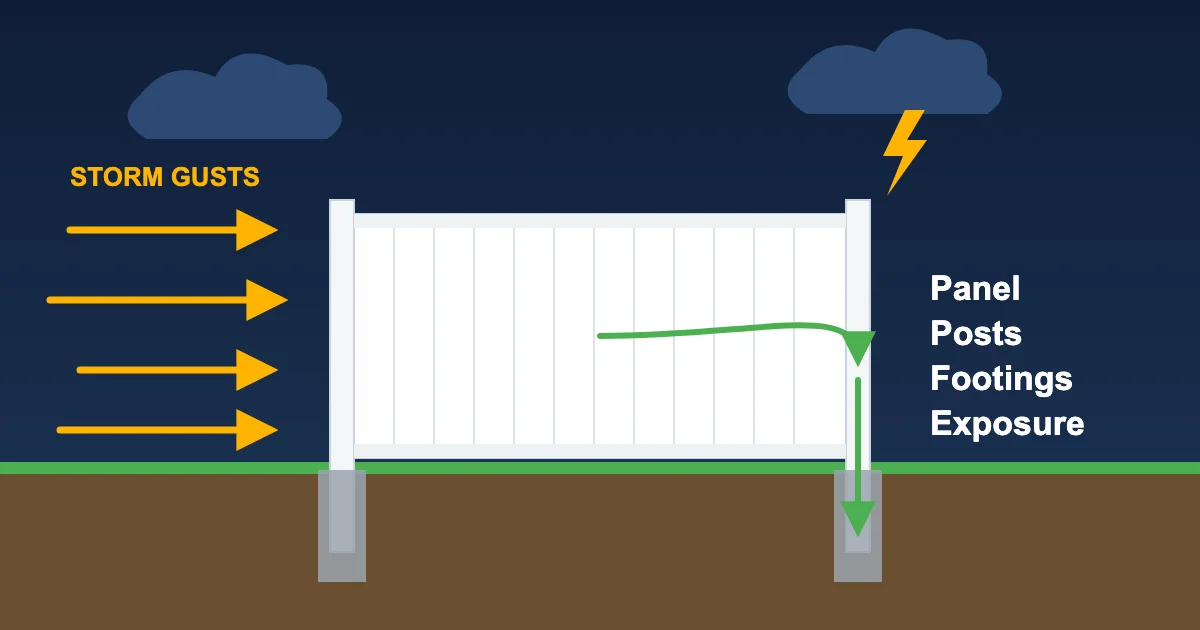
Yes. A properly set PVC fence can stand up to a Brisbane storm, and how well it rides out the wind comes down to four things: how the posts are set, how deep and solid the footings are, which panel style is on each run, and how exposed that side of your block is. Three of those four are about how the fence is built and where it stands, not the PVC itself.
Our panels are made from UV-stabilised virgin PVC, sold as a product that won't rot or rust, and they come with a 30-year limited manufacturer's warranty.
Listen to this guide
Listen to this guide, about 6 minutes. The transcript below matches the audio.
Read the transcript
What a Brisbane storm throws at a fence
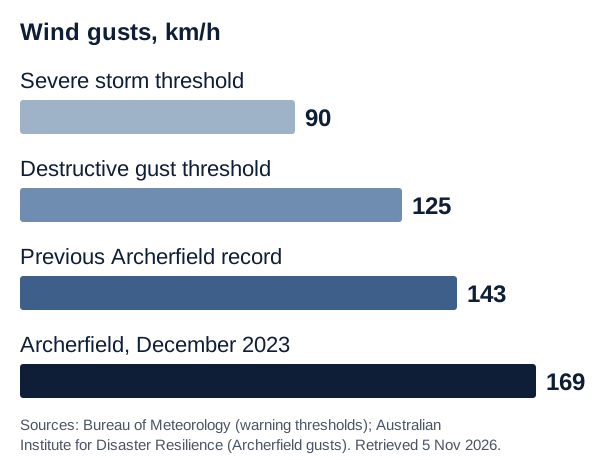
A severe Brisbane storm can push on a fence with gusts well above 90 km/h. The Bureau of Meteorology classes a thunderstorm as severe when it produces wind gusts of 90 km/h or more. Hail of 2 cm or larger, heavy rain that could cause flash flooding, or a tornado also count. Gusts of that strength "can cause damage to vegetation and buildings", and the Bureau adds the words "destructive wind gusts" to its warnings at 125 km/h (Bureau of Meteorology, retrieved 5 November 2026).
Brisbane has seen far stronger gusts. In the storm of 15 to 16 December 2023, gusts reached 169 km/h at Archerfield Airport, above the previous local record of 143 km/h (Australian Institute for Disaster Resilience, retrieved 5 November 2026). The Bureau says the warmer months from September to March are the peak season for severe thunderstorms, so the months ahead are the ones to plan for.
Australia's wind-loading standard, AS/NZS 1170.2, maps the country into wind regions for structural design (Geoscience Australia wind regions dataset, retrieved 5 November 2026). The same design rules also weigh how exposed a site is, and that is the part you can check on your own block, as the exposure section below explains.
Height matters too. A taller fence has more face for the wind to push on, so check how high your fence can go and how high it needs to be before settling on 1800 mm panels for every run.
The Bureau of Meteorology explains what makes a thunderstorm severe in this short video.
Video from the Bureau of Meteorology. It loads from YouTube only when you press play. Watch on YouTube.
How much wind your panel catches
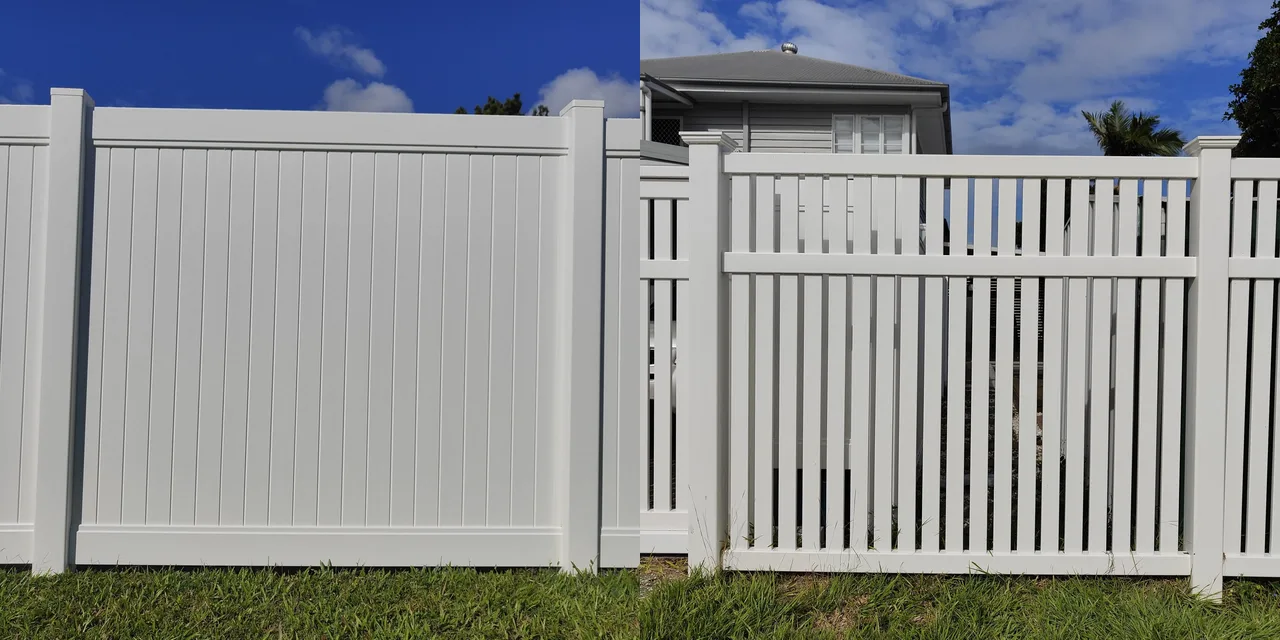
A solid panel catches the full push of the wind, and a slatted panel lets some of it through. Panel style is a choice you make run by run.
The Moreton full privacy panel has solid tongue-and-groove boards running its full height, so it blocks every line of sight and presents an unbroken face to the wind. The Stradbroke partial privacy panel pairs solid lower boards with spaced upper slats that let light and breeze through. The Hamilton and Bulimba semi-privacy panels use spaced slats that let air pass along the whole panel.
Research on slatted windbreak fences backs up what you would expect. In tests of slat-fence windbreaks that were solid, 20, 40 and 60 per cent open, the drag coefficient "decreased linearly with increasing porosity until the windbreak was 40 percent open" (Hagen and Skidmore, Transactions of the ASAE, 1971, retrieved 5 November 2026). That study measured windbreaks, not PVC panels, so treat it as the direction of the effect rather than a number for your fence: more open panels catch less wind.
| Panel | Face to the wind | Good fit for |
|---|---|---|
| Moreton full privacy | Solid boards, full height | Side boundaries between houses, where privacy is the main concern and neighbouring buildings break the wind |
| Stradbroke partial privacy | Solid lower section, spaced slats along the top | Runs that need screening at eye level with some air moving through |
| Hamilton or Bulimba semi-privacy | Spaced slats across the whole panel | Exposed runs, front yards and boundaries facing open ground |
| Picket styles (1200 mm) | Lower height; open-top styles have gaps between pickets, closed-top and dual-layer styles are fuller | Front fences, where height and face area are both smaller |
You don't have to choose one style for the whole block. You can run full privacy along sheltered side boundaries and semi-privacy along an exposed back or corner run. See the full privacy panels and semi-privacy panels, or the guide to choosing a panel pattern.
What holds the fence up: posts, spacing and footings
Posts and footings decide whether a fence stays upright in a storm. When wind pushes on a panel, the rails pass that load to the posts, and the posts pass it down into their concrete footings and the ground around them.
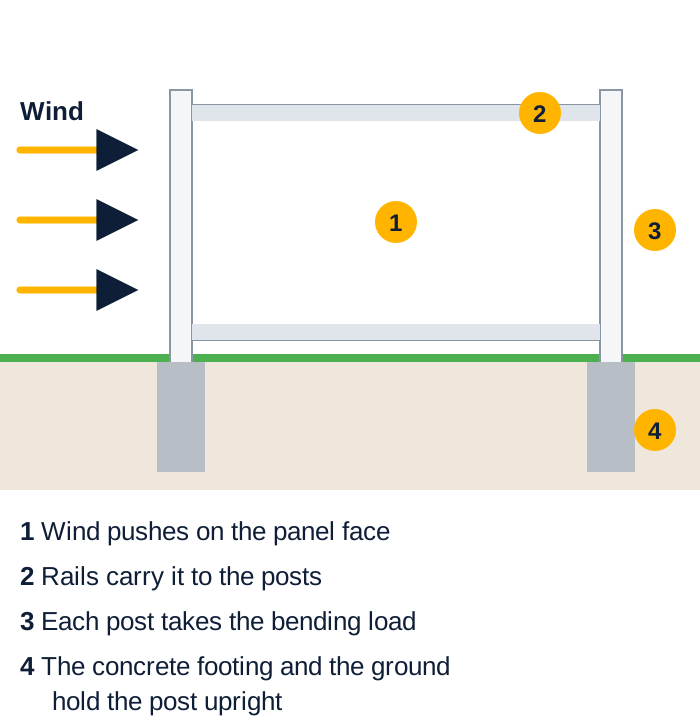
Our PVC fence installation guide has each post set in concrete, in a hole at least one-third of the post's height deep and three times its width, with full privacy posts about 2,450 mm apart centre to centre. Those are the details to compare between quotes, because they change how much of the storm's push each post has to carry and how firmly the ground holds it.
If a post moves at its base, the rails it carries move with it. On any part of your block that stays soft or wet after rain, ask how the footings will be set there.
How exposed your boundary is
The more open ground the wind crosses before it reaches your fence, the harder it pushes. The wind standard builds this in: it uses a terrain category to describe how exposed a site is, and smoother, more open approaching ground means higher design pressures (CSR Gyprock and Rondo technical summary of AS/NZS 1170.2:2021).
On a typical Brisbane block, these runs usually take the most wind:
- Corner blocks, where two sides face the street
- Back fences facing parkland, a sports field, a creek corridor or a vacant lot
- Fences on a rise or along the top of a slope
- Long straight runs with no buildings or trees beside them
- Gaps between houses that funnel wind through
A side fence between two houses is usually the most sheltered run on the property. Walk your boundary on a windy afternoon and note which sections take the wind. That list is what you take to a quote: exposed runs are where a semi-privacy panel, closer post spacing or a deeper footing earns its place.
Questions to ask before you sign a quote
A good quote answers these for your property:
- Which panel style goes on each run, and why?
- What posts are used, and how far apart are they on the exposed runs?
- How deep are the footings, and are posts set in concrete?
- How are gates hung and latched, and which post carries the gate?
- What changes on the corner, the rise or the run facing open ground?
- What does the 30-year limited manufacturer's warranty cover?
We don't publish a wind rating for our panels, and you should be wary of a single number that claims to cover every block. How a fence handles wind depends on the panel, the posts, the footings and where it stands. The honest answer comes from looking at your site, so tell us which runs face open ground when you request a quote. You can call us on (07) 3186 9711 to talk it through.
After a big storm: a walk-along check
A few minutes along the fence line after a storm will catch small problems before they grow.
- Push each post at chest height. It should feel firm. Any rocking at the base is worth a call.
- Look along the rails for a dip or a gap between panels.
- Open and close each gate. It should swing freely and latch without lifting.
- Check every panel is seated in its rails and posts.
- Clear branches and debris leaning on the fence, so they don't keep pushing on it.
- Take photos of anything that has moved, before you tidy up.
If the fence is shared with a neighbour
If a storm damages a fence you share with a neighbour and it needs fixing straight away, Queensland's Neighbourhood Disputes (Dividing Fences and Trees) Act 2011 lets an owner carry out urgent work without first giving notice, where giving notice is impracticable. The work restores the fence to a reasonable standard, having regard to its state before the damage. The cause of the damage doesn't change this. The owner can then ask the neighbour to contribute with a notice in the approved form that states why the work was urgent and includes a receipt for the cost (sections 28 and 32, Queensland legislation, in force 1 August 2025). This is general information, not legal advice.
Storm and wind questions about PVC fences
Are PVC gates strong in wind?
A gate is a panel on hinges, so it catches wind like any other section, and the load lands on the hinge post and the latch. Keep gates latched before a storm, and ask your installer which post carries the gate and how it is set. Our PVC gates page covers the gate styles, and the guide to planning a PVC gate covers openings and use.
What type of fence is most wind-resistant?
On the same posts and footings, a panel with gaps in its face, such as the slatted semi-privacy styles, catches less wind than a solid one. Whatever the style, posts at sensible spacing set in solid footings are what keep it standing.
Do PVC fence panels have a wind rating?
No. We don't publish one, because how a fence handles wind depends on the whole build and the site. Ask for an answer for your block instead.
Who pays if a storm damages our shared fence?
Generally, both neighbours share it. Queensland's dividing fences Act makes adjoining owners each liable to contribute equally to a sufficient dividing fence, and an owner who wants a better fence than that pays the extra (section 21). Urgent storm repairs can be done first and a contribution sought afterwards, with the approved notice and a receipt (sections 28 and 32). This is general information, not legal advice.